文章: How to Tell If a Sweater Is Truly Handmade
How to Tell If a Sweater Is Truly Handmade
The word handmade is everywhere in fashion. But what does it actually mean when it comes to knitwear?
A sweater can look artisanal without ever having passed through the hands of a knitter. Machines can reproduce irregular textures, chunky stitches and even details that appear handmade at first glance.
Truly handmade knitwear is different.
After many years of designing knitwear and working directly with skilled knitters and small European workshops, I have learned that there are certain details that tell a story. Some are visible immediately. Others only reveal themselves when you look more closely.
Here are some of the things I look for.

1. Look closely at the stitches
Hand knitting has a rhythm of its own.
Even an exceptionally skilled knitter will create tiny variations in tension. One stitch may sit slightly differently from the next. A cable may have subtle movement. The surface doesn't have the absolute mechanical regularity associated with industrial knitting.
These variations should be subtle — handmade does not mean badly made.
In beautiful hand knitting, the overall workmanship is consistent while still retaining small traces of the person who made it.
That is part of its character.
2. Examine the finishing
One of the best places to investigate a sweater is somewhere most people don't look: inside.
Look at seams, joins, edges, cuffs and finishing around the neckline.
A beautifully handmade garment will usually show careful finishing and evidence of construction by hand. Depending on the design, you may find hand-sewn seams, individually finished yarn ends or details that have clearly been assembled rather than cut from a large piece of knitted fabric.
The inside of a garment can tell you almost as much about its quality as the outside.
3. Look for techniques that require real handwork
Certain details are particularly difficult to reproduce convincingly through mass production.
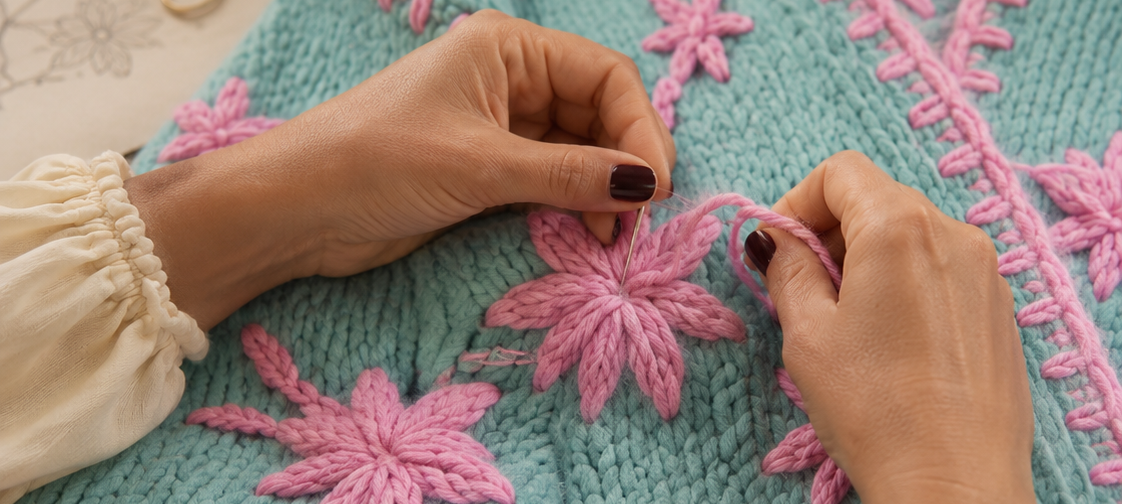
Hand embroidery, crochet, blanket stitching, individually applied sequins and decorative yarn work all require time and control.
On some of our own designs, for example, embroidery is added after the garment has been knitted. Flowers, lettering or decorative stitches are worked individually onto the finished knit.
The result is never absolutely identical from one garment to another.
And it shouldn't be.
4. Compare two pieces of the same design
If you ever have the opportunity to see two handmade sweaters of the same style next to each other, look closely.
They should clearly be the same design, but they may not be perfect twins.
A hand-embroidered flower might sit a few millimetres differently. The character of a fringe can vary slightly. The tension of a hand-knitted section may create a tiny difference in measurement.
These are not necessarily defects.
They can be evidence that two garments were actually made individually rather than produced as identical units by a machine.

5. Consider the construction
Handmade knitwear is often constructed differently from industrial knitwear.
Pieces may be knitted separately and assembled by hand. Decorative elements can be incorporated during knitting or added afterwards. Complex colour combinations, oversized stitches, crochet sections or unusual surface techniques may require several stages and sometimes more than one craftsperson.
This is one reason a handmade cardigan can take many hours — and sometimes several days — to complete.
The complexity of the design matters enormously.
A simple scarf and an oversized cardigan with intricate stitches, embroidery or embellishment cannot realistically require the same amount of work.
6. Ask where and how it was made
Perhaps the simplest test is also one of the most important.
A brand selling genuinely handmade knitwear should be able to explain who makes it, where it is made and how it is produced.
You don't necessarily need the name of the individual knitter who made your sweater. But there should be transparency about the process.
At Kitty van Coesant, our knitwear is produced in small European workshops and by skilled knitters with whom we work closely. Many techniques cannot simply be transferred to an automated production line because the handwork is an essential part of the design itself.
For me, knowing how something was made is part of understanding its value.
Handmade does not mean imperfect
There is an important distinction here.
Sometimes handmade is used as an excuse for poor workmanship.
It shouldn't be.
A luxury handmade sweater should still be beautifully constructed, wearable and carefully finished. The small variations associated with handwork are very different from loose seams, incorrect sizing or careless finishing.
The beauty lies in controlled irregularity: evidence of the human hand within a piece that has been made with skill.
Why does it matter?
Because handmade knitwear represents something increasingly rare in fashion: time.
Someone has physically worked on that garment.
A person has held the needles, controlled the yarn, formed the stitches, changed colours, created the embroidery or finished the seams.
That time cannot simply be accelerated by ordering another thousand pieces.
It is also why genuine handmade knitwear will never compete with mass-produced knitwear purely on price — nor should it try to.
You are buying material, certainly. But you are also buying hours of skilled work and knowledge accumulated over years.
The preservation of traditional craft skills is increasingly recognised as an important part of protecting cultural heritage.
Is handmade knitwear worth it?
That depends on what you value.
If the only objective is to own a sweater, there are much cheaper ways to buy one.
But if you value craftsmanship, natural fibres, small-scale production, individuality and the knowledge that human hands were involved in creating what you wear, handmade knitwear offers something fundamentally different.
For me, that difference is exactly why I have continued working with hand knitting throughout my career.
Fashion changes constantly.
The pleasure of something beautifully made doesn't.
Frequently Asked Questions
How can you tell whether a sweater is hand knitted or machine knitted?
Look at the consistency of the stitches, construction, seams and finishing. Hand knitting often shows very subtle variations in tension and individual character, while machine knitting tends to be extremely uniform. However, experienced hand knitters can work remarkably evenly, so stitch irregularity alone is not proof.
Does handmade mean a sweater is completely made by hand?
Not always. Handmade knitwear can describe garments involving different combinations of hand knitting, hand crochet, hand assembly, embroidery or other hand-applied techniques. A trustworthy brand should be clear about which parts of the process are done by hand.
Why is handmade knitwear more expensive?
The biggest difference is time. A skilled maker may spend many hours or days producing a single garment. High-quality yarns, small production quantities and labour-intensive techniques such as embroidery, crochet and embellishment also contribute to the price.
Are small differences between handmade sweaters normal?
Yes. Small variations in stitch tension, embroidery placement, measurements or decorative details can naturally occur when garments are individually made. These variations should not affect the overall quality or fit of the piece.
Is hand-knitted clothing better quality than machine-knitted clothing?
Not automatically. Both can be made beautifully or poorly. The value of hand knitting lies primarily in craftsmanship, individuality and the techniques that become possible when a garment is created one piece at a time.
At Kitty van Coesant, craftsmanship has always been at the heart of our knitwear. Discover our handmade and hand-finished knitwear collections, created in small quantities in Europe.